Combat-induced desensitization to violence
I Heard You Paint HousesCombat-induced desensitization to violence is the lasting hardening that Frank Sheeran associated with his prolonged service in World War II. In the book, it develops through repeated exposure to danger, killing, and death rather than through one defining episode: battlefield habits that made survival possible gradually displaced civilian moral restraints, and continued to shape his life after he returned home. The account treats that change both as a personal condition and as a subject that Sheeran struggled to recall and describe.
Identity and Scale of the Experience
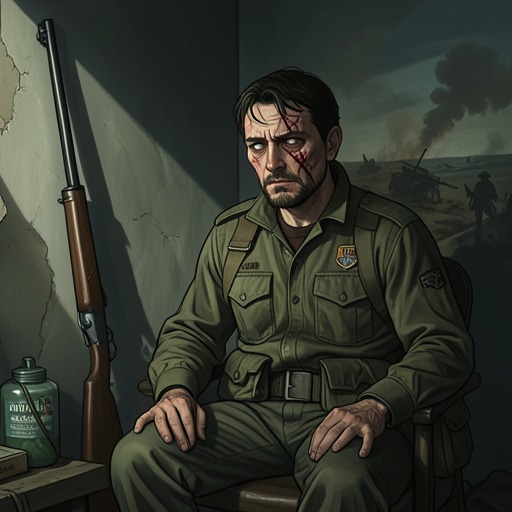
Sheeran served as a rifleman in the 45th Infantry Division, where the scale of combat made his own service unusually prolonged. The Army credited him with 411 combat days; the division’s official report recorded 511 days of combat and 21,899 battle casualties. A fully staffed division numbered about 15,000, and Sheeran remembered replacements arriving and being carried away day after day. He had entered the war as a young man and, despite the length of his exposure and the firefights he endured, was never hit by a German bullet or shrapnel. The account’s emphasis is therefore not on a wound visible on his body, but on what repeated exposure did to his habits and outlook.
The numbers establish a contrast between surviving physically and remaining unchanged psychologically. Sheeran described himself as one of the lucky ones, while the book notes that other veterans reacted with astonishment to the prospect of 411 combat days. With periods of rest and rehabilitation included, his exposure amounted to more than 80 percent of the division’s total days in combat. The interviewer’s interpretation is that the sustained experience of killing, maiming, and waiting to be killed conditioned Sheeran for the rest of his life. That conclusion emerges from the scale of the service as well as from Sheeran’s later descriptions of his emotional state.
How Combat Replaced Civilian Rules
Sheeran described a shift in which reflection narrowed under fire. Before a battle or landing, he said, nervousness could build; once shooting began, there was no time to think, and a soldier did what had to be done. The feelings and consequences came afterward. This sequence helps explain the book’s distinction between an immediate survival response and the deeper change produced by repeating it: actions first taken under pressure could, with time, become ordinary enough to require little conscious consideration.
In combat, Sheeran said, a person might have only a split second to act as judge, jury, and executioner. He described two rules he had to obey: return to his unit when ordered back to the line, and obey a direct order in combat. Outside those constraints, he said, soldiers could defy authority and lose the moral judgment they had built in civilian life, replacing it with their own rules. He compared the resulting hardening to being encased in lead. Fear did not disappear; rather, people learned to act while frightened and, if they remained in combat long enough, could stop thinking about acts that once might have disturbed them. His comparison to scratching an itch conveys how violence could become procedural, without making it harmless.
Anzio and the Repetition of Danger
The account gives this conditioning a particularly concrete setting at Anzio. After the 45th Infantry Division was moved from the prolonged fighting at Monte Cassino, the Allied landing initially surprised the Germans, but a delay in advancing allowed German forces to bring up tanks and artillery. Sheeran described the ensuing four months under attack: soldiers dug shelters about eight feet deep, stayed below ground during daylight, ate canned K-rations, and came out at night when they could. They played cards, talked about life after the war, and prayed. The routine of sheltering, waiting, and enduring bombardment made danger less an interruption than the surrounding condition of daily life.
Night brought the artillery the soldiers nicknamed the Anzio Express, whose shells sounded to Sheeran like a boxcar overhead. The sound was frightening and demoralizing; it also made the possibility of sudden death impossible to keep at a distance. Soldiers took turns at an outpost on the perimeter, a hundred yards from the main position, while shelling continued during the day. Twice the Germans advanced against their position, and the men held on. Sheeran later recalled praying in a dugout and described himself as lucky never to have been struck. In this account, repetition does not mean habituation made danger disappear: it means the men had to build an inner hardness to keep functioning amid a danger that kept returning.
Prisoners and the Erosion of Restraint
Sheeran’s account of handling German prisoners shows how that hardening could shape conduct after the immediate exchange of fire. He described the anger soldiers could feel toward men who had been shooting at them and killing their companions, then surrendered. A small group of prisoners might be treated differently from a larger load that could be escorted behind the lines; he also cited the possibility of prisoners trying to escape. He said that a lieutenant gave him many prisoners to handle and that he did what he had to do. The account does not present this as a detached moral principle. It places his actions within a setting where retaliation, practical limits, and collective expectation could blur the distinction between taking prisoners and killing them.
The later march through Germany provides another stark example. After the company intercepted a mule train carrying hot food to German soldiers, the American troops ate what they wanted and spoiled the rest. They left the German women who had prepared the food alone. The German soldiers driving the mules, however, were not taken along as the American troops advanced; Sheeran said they were given shovels to dig shallow graves. His reflection that he thought nothing of doing what was required by that point in the war marks a change in the emotional meaning of violence. The scene shows the contrast between a limit that remained in place in one encounter and the casual expectation of lethal action in another, without suggesting that the surrounding conditions erased the consequences.
Return, Delayed Recall, and Lasting Change
Sheeran’s homecoming makes the persistence of the change visible through another person’s recognition. In October 1945, on the dock at Havre de Grace, he encountered his younger brother Tom as they prepared to return to Philadelphia on separate ships. Tom told him he was no longer the brother he remembered. Sheeran understood the remark as a response to what 411 combat days had done to him, perhaps visible in his face or stare. He described himself as tightened inside overseas and said that he never loosened up again: death and killing had become familiar, and ordinary enjoyment retained an edge.
The return did not immediately restore civilian routines. Back in West Philadelphia, Sheeran went to live with his parents and resumed work as an apprentice at Pearlstein’s, but quit after a couple of months because he could not bear being confined to a job under supervision. He often woke from nightmares unsure where he was, surprised to find himself in a bed, and said he never slept more than three or four hours a night. At the time, he recalled, people did not talk about experiences like his as war syndrome. He nevertheless knew that something had changed, and that memories of what he had done and seen returned despite efforts not to think about them.
The effects also surfaced belatedly in the act of telling. The interviewer found Sheeran’s combat experiences the most difficult subject to elicit; two years passed before Sheeran could accept that the subject was worth discussing, and the interviews proceeded through stressful stops and starts. To help reconstruct the history, Sheeran located the 45th Infantry Division’s 202-page official Combat Report. Years later, stirring up the memories brought back dreams of combat mixed with things he began doing for certain people after the war. The movement from reluctance, to documentary reconstruction, to dreams gives the concept a narrative shape: what could not readily be spoken of continued to return, and the account connects wartime conditioning with later conduct without treating memory as a simple or complete record.
Sheeran also described a lasting change in how he thought about death. After initially thinking about dying, he concluded that he had no control over when it would come and adopted the idea that what would be would be. The belief registers as fatalism, but in the account it follows from survival after repeated danger: the man who had once prayed to get through the next bombardment returned home with diminished concern about what might happen to him. Combat-induced desensitization thus names more than reduced feeling at the moment of violence. It encompasses the altered rules, habits, and expectations that persisted after the fighting stopped.